











 |
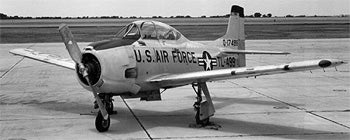
| STANDARD DATA: Seats 2. Gross wt. 6,759. Empty wt. 5,111. Fuel capacity 125. Engine 800-hp Wright radial. PERFORMANCE: Top mph 288. Cruise mph 190. Stall mph 72. Initial climb rate 2,570. Range 1,008. Ceiling 29,800. Takeoff distance (50′) 1,308. |
The North American T-28 was the first U.S. military trainer to be outfitted with tricycle landing gear. It was designed for the U.S. Air Force as a replacement for the AT-6 as an advanced trainer. Production began in 1950 and was discontinued eight years later. Several different versions of the T-28 exist. Some of the original T-28s were built for the air force, while others were constructed for the navy. A number of them were subsequently supplied to foreign countries. Finally, the latest version with a 1,425-hp engine was constructed for counterinsurgency warfare in the early 1960s. Another version produced during the same period was powered by a 2,450-shp Lycoming turboprop engine to increase the aircraft’s maximum speed to 360 mph and gross weight to 15,530. The T-28 is considered to be easy to fly so long as the engine is operating at full power. When power is reduced, the rate of descent is spectacular.