











 |
| STANDARD DATA: Seats 5-11. Gross wt. 8,500. Empty wt. 5,600. Fuel capacity 223. Engines two 380-hp Lycomings. PERFORMANCE: Top mph 265. Cruise mph 240. Stall mph 82. Initial climb rate 1,285. Range 1,495. Ceiling 28,500. Takeoff distance (50′) 1,560. Landing distance (50′) 1,450. STANDARD DATA: Seats 5-11. Gross wt. 7,000. Empty wt. 4,330. Fuel capacity 233. Engines two 340-hp Lycomings. |
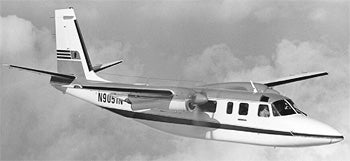
The Aero Commander 680 and Grand Commander are two of the larger versions of the basic Aero Commander design that appeared in profusion during the nearly two decades of type production. These particular models are king-sized with greater gross weight and more seating capacity. There is also a pressurized version. The basic characteristics, allowing for differences due to larger dimensions, are essentially similar to the more familiar, but smaller, Commander twins. Ease of handling in the air, exceptional short-field ability for the bulk and performance, and good economy at fast cruising speeds are notable, plus even greater pilot and passenger comfort. All Commander twins came off the same production line in Oklahoma.
The engines on the Commander 680 have always been supercharged, and the very earliest versions have some reputation for engine malfunctions if not operated with care. From 1955 to 1960, the Super and 680E were powered by 340-hp Lycomings. The 380-hp engines were first used in 1960, and the designation was changed to 680F or 680FL Grand Commander. In 1962, pressurization became available as an option. Another major option became available in 1967, a choice of turboprop power in place of the conventional reciprocating engines. Finally, in 1968, the 680 designation was dropped and the name changed to Courser for the last two years of production, 1968-69. The Rockwell 685 Commander was the final piston-powered model.