











 |
| STANDARD DATA: Seats 239. Gross wt. 240,000. Empty wt. 126,250. Fuel capacity 9,370. Engines two 40,100-lb. s.t. Pratt & Whitney PW2037 turbofans. PERFORMANCE: Top mph 581. Cruise mph 528. Ceiling 40,000+. Range 4,570. Takeoff distance 10,450. Landing distance 4,600. |
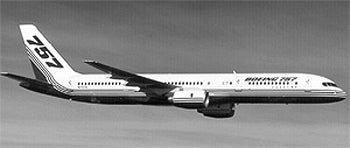
The Boeing 757-200 is a medium-sized, twin-engine jetliner designed for medium-to-long-range service and takes advantage of advanced technology for exceptional fuel economy, increased passenger comfort, lower noise levels, and elevated operating performance. The 757 also offers great versatility with a wide weight range (220,000-255,500 pounds) for greater payload capability. A freighter version is also available. The 757 is designed to carry 194 passengers in a typical mixedclass configuration and can carry an additional 45 passengers for charter service, which brings the 757’s overall capacity between that of the 737-400 and the 767.
The 757-300 made its debut in at the Farnsborough Airshow in 1996. Though the aircraft shares the same wing and fuselage as the original 757, a fuselage stretch of just over 23′ allowed 20% more seats, and freight increase of 40%. The first model 757-300 went into service in 1999.