










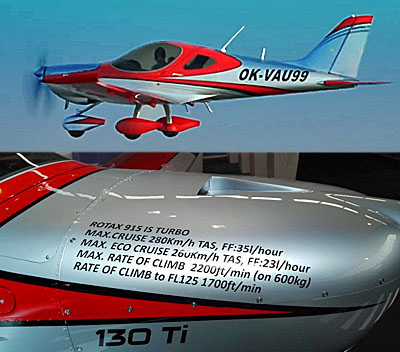

Surely all readers know that Rotax-brand engines dominate the light aircraft landscape. The company owns something like 75% or more of the global market and close to that in the USA. Some worthy competitors are keeping the pressure on, but Rotax continues forward. The engine-to-follow is their new turbo-intercooler-fuel injected 135-horsepower 915 iS variant.
 Rotax Aircraft Engines first announced this new model at AirVenture 2015; see our video interview for details and go to the official 915 iS page for even more.
In the press conference where the engine was unveiled, many in the standing-room-only audience were airframe manufacturers. As soon as the management and engineering team was done presenting, they quickly swarmed over the powerplant. You could almost see the wheels turning in their minds as they contemplated how they could fit and use this machine in their aircraft.
That was almost two years ago — AirVenture Oshkosh is only about 75 days away! The company said the 915 iS would be available in the last half of 2017. With that date approaching, how is it going?
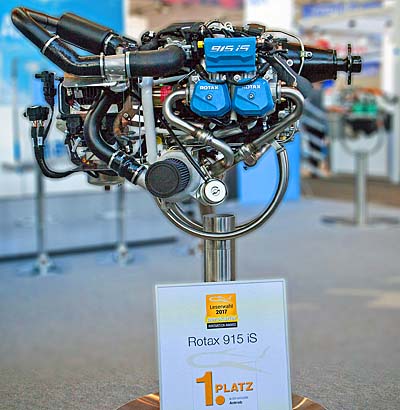
Quite well, it appears. First, at the Aero 2017 show, Rotax was given a powertrain of the future award from Germany’s large Aerokurier magazine for the 915 iS aircraft engine (photo).
“We are pleased about the great response of Aerokurier’s readership, who voted for our Rotax 915 iS aircraft engine as “powertrain of the future,” said Thomas Uhr, Vice-President Powertrain BRP. The reader’s poll was divided into six categories to permit votes on the most innovative products that will influence on the aircraft industry.
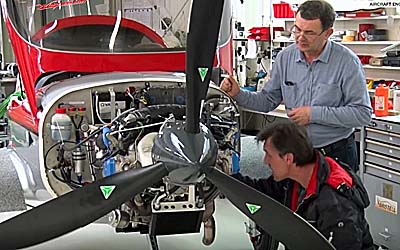
Given the initial stampede to look over the 915 iS, which companies are actively working with the product?
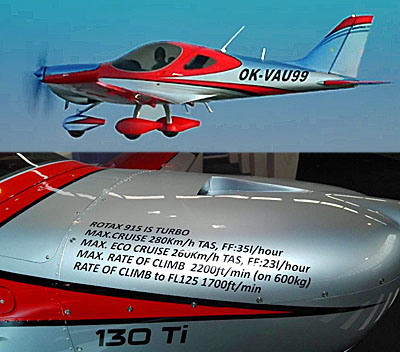 BRM has been flying a prototype aircraft with the 915 iS engine installed. Their preliminary flying shows some solid results.
- Maximum Cruise: 280 km/h — 175 mph — 152 knots
- Eco (lower fuel consuming) Cruise: 260 km/h — 163 mph — 141 knots
- Fuel Burn in Eco mode: 23 liters/hour — 6 gallons per hour
- Fuel Translation: 27.16 statute miles per gallon at 163 mph