










With the ever-rising bar of expectations for military aircraft, engines had to get more powerful, more reliable and sleeker, too. A couple of inline and V-configuration engines got some momentum in the 1910s, including the Liberty V-12, which powered some WWI aircraft late in the war, as well as ground vehicles and boats. A powerful engine, the V-12 version could produce 400 hp, far greater output than the rotary engines it supplanted. The downside was that much of that additional power was for naught, lost on the draggy and inefficient aircraft it was fitted into.
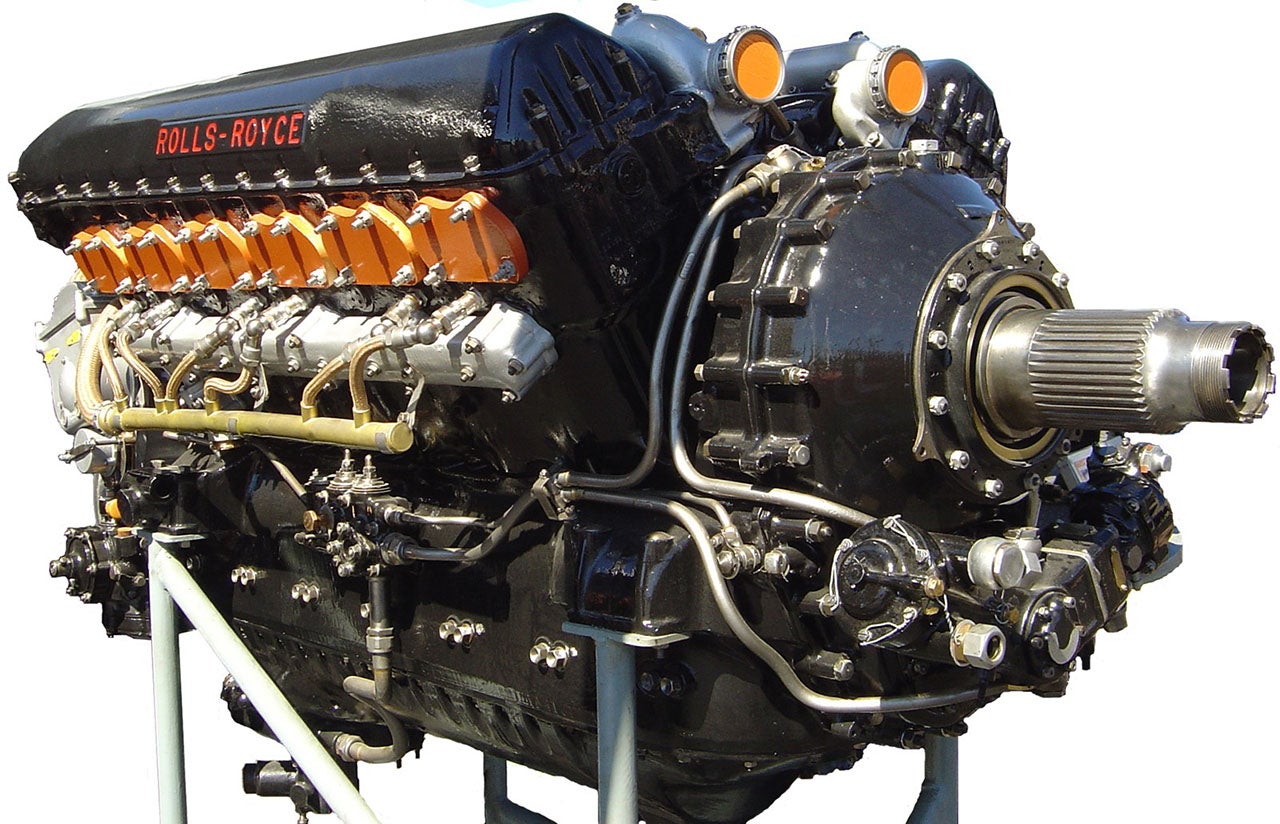
But as aircraft throughout the 1920s and early ’30s got more aerodynamically efficient, V-configuration engines came into their own. By 1933, British firm Rolls-Royce flew the first prototype of what would go on to become the most legendary engine of the coming global conflict, a supercharged (in most applications) V-12 engine that produced a sound that some call the most beautiful engine sound ever produced—I am of that opinion, too. That early prototype was buggy, had serious cooling problems, and didn’t deliver near the hoped-for power output of 1,000 horsepower. But it had promise, and the company continued to develop it, working through the engine’s issues, like cooling, which designers largely overcame with a conventional liquid-cooling system.
By 1936, the V-12 was producing better than 1,000 hp and began going into the production of military aircraft. The Supermarine Spitfire prototype had used an earlier prototype of the Merlin engine; it would go on to use production versions of the Merlin. The model 45 produced 1,470 hp, more than 10 times the power of the most widely used fighter plane engines of WWI, which had unfolded just 20 years earlier.
Arguably, the ultimate expression of the Merlin-powered fighter is the North American P-51D Mustang, which was outfitted with a version of the Rolls-Royce Merlin built by Packard in the United States, which could turn out 1,490 horsepower under normal operations and 1,790 in emergency (war emergency power) mode. With the big Merlin, the P-51 helped turn the tide of the war with its great range, which allowed it to accompany B-17 bombers deep into enemy territory, and great speed, making it more than a match for the fighters of the Luftwaffe, with the exception of the Me-262—but more on that plane in a bit.