










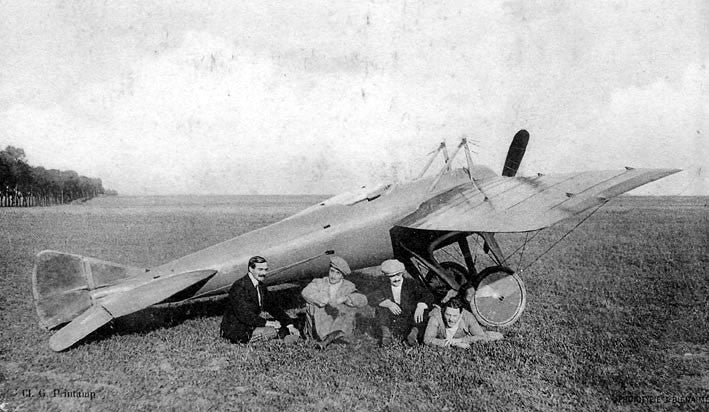
If you were expecting to see one of Orville and Wilbur’s planes here, sorry. While the Wrights and North Carolina were first in flight, numerous innovators surpassed the Wright Aircraft Company soon after 1903. Just before a decade had transpired, the Brothers’ lack of design agility was catching up to them. When the French company Deperdussin built its Monocoque model, it was about five times faster than the original Flyer and featured independent three-axis controls instead of the already-obsolete wing warping of early Wright designs. But the thing that made this plane a special set of wings was the fuselage, which, as the name indicates, was constructed with a load-bearing skin, in this case, built of laminated plywood. This made it sleeker and lighter than competing designs. It would take the rest of the world a while to catch up, but the Monocoque design would before long become the de facto design standard.
Deperdussin Monocoque, 1912

Key Takeaways:
- The Wright Brothers' aircraft designs quickly became outdated due to their lack of design agility, despite their pioneering "first in flight" status.
- Less than a decade after the original Flyer, the French Deperdussin Monocoque plane offered significant advancements, including much higher speed and independent three-axis controls.
- The Monocoque's key innovation was its load-bearing fuselage constructed from laminated plywood, making it sleeker and lighter than contemporary designs.
- This innovative Monocoque design eventually set the standard for aircraft construction worldwide.
See a mistake? Contact us.