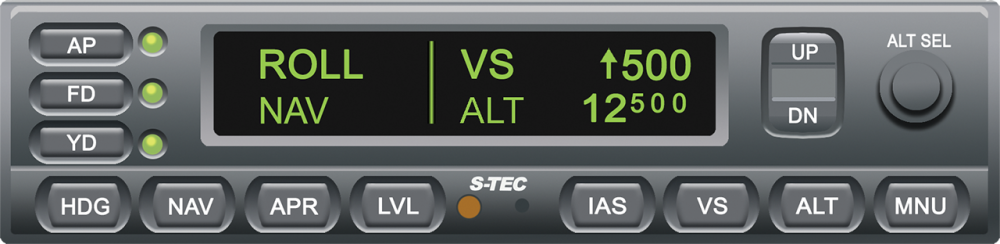











To many pilots, an autopilot is a dumb mechanical aid, something you can use to take a look at the chart without going off course or busting altitude. And they are that. But today’s digital autopilots are so much more, too.
Autopilots work on one common principle. The system uses navigation, heading and attitude inputs to activate servos to keep the plane going where the pilot has programmed it to go. In its simplest form, an autopilot keeps the wings level while ignoring all other parameters—this is more helpful than one might imagine; the loss-of-control chain in instrument conditions is typically begun by an uncommanded, steep bank, causing the plane to enter a spiral dive, building airspeed and making a recovery, especially when the plane is still in IMC, a dicey proposition.
Autopilots have inspired aviation dreamers to imagine what it might be able to do. Could it keep the plane on altitude, too? Tie it into the baro system, and of course it could. Could it follow a pre-programmed nav course? Yup. Just couple it to the nav receiver. Could it fly an approach? Ditto. Yup, that too. Keep the tail from wagging. Even that.
From there, engineers have gone to fantastic places. Today’s autopilots can work in the background, providing protection from surprise deviations in pitch, bank angle and airspeed, keeping the plane from getting either too slow or too fast. And several models today feature a single button the pilot can push to return the plane to straight and level flight in case of accidental loss of control (upset).
Autopilots have gone from being an expensive luxury to an indispensable tool for helping pilots keep the plane under control and assisting in flying very precise approaches, as well.