










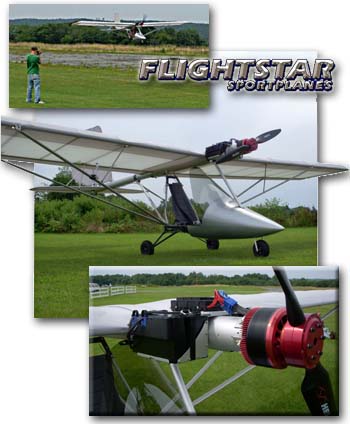
Part 103 continues to step from the shadow of Light-Sport Aircraft. We’ve had aviation’s simplest rule (worldwide!) for 27 years and with few exceptions, most of those years saw Part 103 producers laboring in near-obscurity. *** Now, however, a new flurry of activity has developed at the beautiful intersection of genuinely lightweight aircraft with electric power. The very latest to roll into the spotlight is Flightstar‘s E-Spyder, which took its first flight today. E-power from Yuneec in China meets an all-American airframe. The accompanying photos show what a clean matchup these components achieve. *** Flightstar mounted the twin lithium polymer battery packs on either side of the design’s robust main fuselage tube. Electric motors are more user-friendly in nearly every way, but you have some new learning to do. For example, experts advise never allowing lithium polymer batters to drain completely. Fortunately, the Yuneec controlling hardware provides warning systems to help you manage this task. *** Batteries last for at least 500 cycle charges and Yuneec says this equates to 250+ hours of flying. That many hours using a small gasoline engine like the Rotax 277 would cost around $10,000 in fuel alone, plus oil, overhaul costs, spark plugs and more such that the up-front cost for batteries is the rough equivalent of buying fuel for a gasoline engine for many years… but you’ll never have to clean an oil mess.