










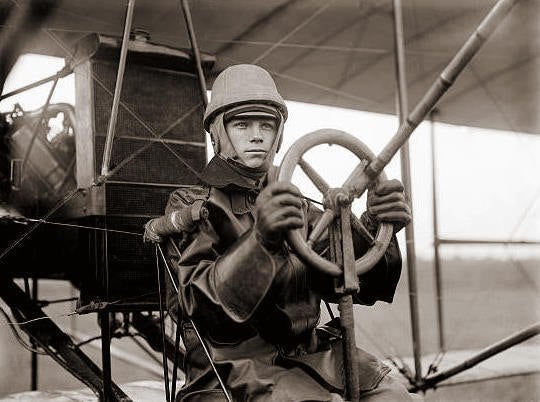
On that chilly December day in 1903 when the Wrights’ Flyer launched on that famous first 12-second journey, Orville, the world’s first PIC, operated a very different set of controls than we’re used to today. Instead of a single integrated mechanism to give the pilot control of two of the three axes of flight (pitch and roll), while lying flat on his belly, he operated the elevator lever with his left hand, and the wing warping, for both bank and yaw, with his hips. The Wrights were making progress backward, as it turned out. By 1903, there was already a single control interface, designed by Austrian Wilhelm Kress, that mixed the input for pitch and roll in a way that would be intimately familiar to modern pilots. Indeed, regardless of how they’re implemented, modern controls, whether center or side stick, yoke, control column or side yoke, pretty much do the same thing in slightly different ways, and Kress had it figured out by the turn of the century—the last century, that is.